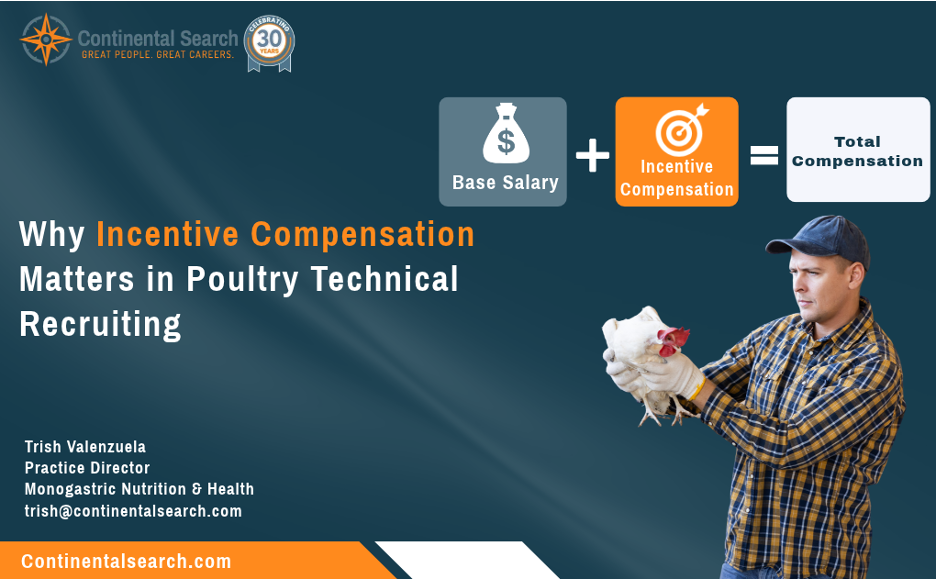
Compensation conversations in Poultry Health & Nutrition can become misleading when employers focus too heavily on base salary.
Our 2026 Animal Health & Nutrition Technical Professional Salary Survey included 25 Poultry respondents within Technical/Sales Support: 19 solo contributors and six managers.
The incentive data stood out.
Among the 19 solo contributors, 42% reported incentive opportunities of 21%-30% of base salary, while another 32% reported incentives of 11%-20% of base salary.
For employers recruiting experienced Poultry technical professionals, that changes how an opportunity should be presented and compared.
A base salary may look competitive on its own and still fall short once the candidate evaluates the entire package.
Incentive Compensation Is a Meaningful Part of the Package
The 19 Poultry solo contributors reported a wide range of total taxable income.
One earned less than $90,000; two reported $90,000-$109,999; five reported $150,000-$169,999; six reported $190,000-$219,999; and five reported $220,000 or more.
The survey defines compensation as total taxable income reported on a W-2, so these figures need to be considered alongside the incentive structures respondents reported.
For a candidate, an incentive opportunity of 20% or 30% can materially affect the value of a current position.
That means an employer cannot always compare a proposed base salary to a candidate’s current base salary and assume the difference represents the actual increase.
The candidate may be considering expected total income.
They may also be evaluating how reliable the incentive has been.
A plan that regularly pays near target will carry more weight than a larger percentage that rarely pays out.
Those details belong in the recruiting conversation.
Candidates Will Want to Know How the Incentive Works
When an employer says a position includes a bonus or incentive opportunity, experienced candidates usually want more information.
How is the incentive calculated?
What determines the payout?
Are the goals individual, team-based, or tied to company performance?
Does the person have meaningful influence over those results?
How often has the plan paid at target?
Are there caps?
Does the structure change from year to year?
These are reasonable questions.
A candidate leaving a familiar employer is being asked to exchange a compensation plan they understand for one they have not experienced.
Clarity reduces some of that uncertainty.
If the incentive is a meaningful part of the package, hiring teams should be prepared to explain it with the same level of detail they use when discussing base salary.
Management Responsibility Changes the Conversation
The six Poultry managers in the survey provide another useful layer of context.
Three supervised one or two employees, with reported taxable incomes of $130,000- $149,999, $170,000- $189,999, and $220,000 or more. The other three supervised three or more employees, and all three reported total taxable income of $220,000 or more.
The management group also reported a variety of incentive opportunities. One reported 0%-10% of base salary, one reported 11%-20%, two reported 21%-30%, and two reported more than 30%.
This is a small group of six managers, so I would not use these numbers to establish a broad benchmark for poultry management.
They do show how quickly the compensation discussion becomes more complex once management responsibility is involved.
A manager may be responsible for people, customer relationships, technical support, territory coverage, hiring, team development, and communication across commercial and technical functions.
Those responsibilities need to be understood before an employer decides whether a compensation package is competitive.
Most Solo Contributors Were Not Actively Looking
Another important point in the Poultry responses is job mobility.
Among the 19 solo contributors, only two were actively seeking another job. One indicated that an increase of up to 10% could be enough to consider changing employers, while the other expected an increase of more than 20%.
That leaves a large group of experienced professionals who were not actively searching.
For hiring teams, this has practical implications.
A candidate who is already employed may have a compensation package they understand, strong customer relationships, technical credibility, and a role they are comfortable performing.
Approaching that person with only the base salary does not give them enough information to evaluate a move.
They need to understand the full scope of the opportunity.
That includes incentive compensation, technical responsibilities, customers, travel, leadership expectations, reporting relationships, and the company’s expectations for what they are to accomplish during the first year.
The Management Group Was Also Selective
Among the six Poultry managers, only two expressed openness to new opportunities, and both indicated that they would consider moving for a compensation increase of more than 20%.
Again, six people are too few to make a broad statement about the Poultry management market.
The result does show why recruiting experienced managers can require a stronger case.
A manager leaving an established organization may be walking away from more than salary.
They may be leaving a team they developed, customers they know well, decision-making authority they have earned, and an incentive plan tied to results they understand.
The new employer should be able to explain what the candidate would be stepping into.
If the company expects the manager to rebuild a team, inherit difficult customer relationships, increase travel, or take on broader responsibility, those details should be discussed early.
Define the Role Before Comparing the Compensation
Poultry technical positions often combine responsibilities that are difficult to capture in a title.
A Technical Services Manager at one organization may spend most of the time supporting customers.
At another, the same title may include people leadership, commercial support, product responsibilities, extensive travel, and significant involvement with key accounts.
Those are different jobs.
Before using survey data to determine whether compensation is competitive, the hiring team should define:
- the technical responsibilities;
- customer and geographic scope;
- management expectations;
- travel requirements;
- incentive structure;
- decision-making authority;
- and first-year objectives.
That gives the company a better basis for comparing the role with the market.
It also gives candidates enough information to evaluate the opportunity seriously.
Use the Survey as Context
The Poultry Technical/Sales Support section provides useful information on compensation, incentive opportunities, management responsibilities, and job mobility among 25 respondents.
It should be used as context rather than as a universal compensation schedule.
The strongest insight for employers is how much of the compensation picture can sit outside base salary.
For many professionals in this sample, incentive opportunities were substantial.
That means employers recruiting Poultry Health & Nutrition talent should understand the full package they are competing against and be prepared to explain the full package they are offering.
That conversation is much more useful than comparing two base salary numbers.
Source: 2026 Animal Health & Nutrition Technical Professional Salary Survey, Continental Search
If you would like to talk about upgrading your team, succession planning, or recruiting the people you will need for 2027, contact me at Trish@ContinentalSearch.com for a confidential conversation.
Trish Valenzuela
Practice Director, Monogastric Nutrition & Health
Continental Search
trish@continentalsearch.com