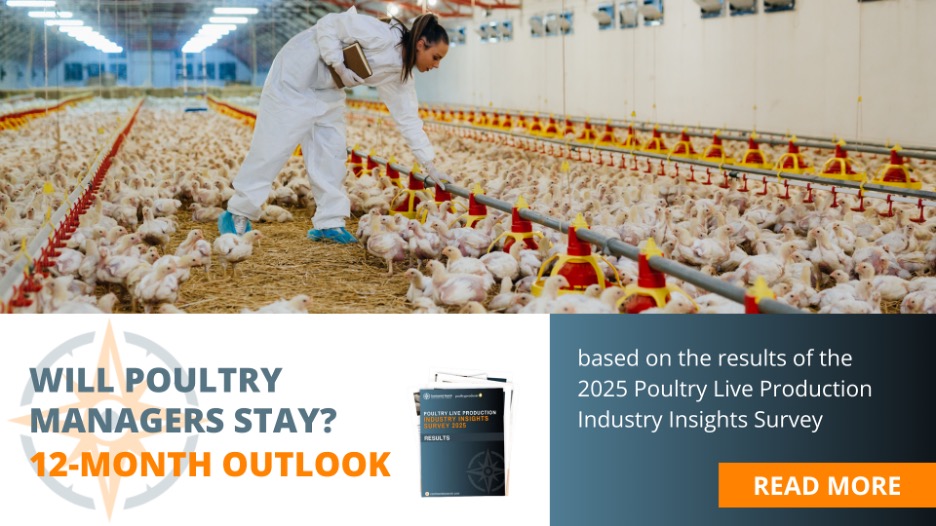
We recently asked professionals in our Poultry Live Production Industry Insights survey whether they expect to remain with their current employer over the next 12 months. The topline result looks reassuring at first glance because most respondents lean toward staying.
With 66.67% selecting enthusiastic “Yes!” and another 7.69% selecting “Yes,”—a clear majority of respondents seeing themselves staying put in the near term, this industry still has a strong culture of tenure. In many industries, that kind of stability would be taken as a sign that retention is under control and that managers are not constantly scanning the market or jumping at the next opportunity.
However, intriguingly, sitting right beside this question in the survey was about their most likely next move. The top answer is retirement at 43.59%. I believe this changes the 12-month retention outlook, because it suggests the industry may have a stable, experienced workforce, that is likely to stay in role in the near term, while also being positioned for a major wave of exits that are not driven by dissatisfaction but by lifecycle.
Here, the conversation may get more complex and more uncomfortable for employers, because retirement-driven stability creates a strange illusion. Things can look calm right up until they are not, and the gap is a knowledge gap. If many leaders plan to retire as their next step, a lot of operational expertise is sitting with people who have learned through years of hard seasons. And if the next generation of managers is not being developed fast enough, the industry may end up trying to recruit experience from a market that cannot supply it on demand.
From a recruiting standpoint, this also reframes what “retention” really means. It is easy for companies to focus on keeping people for the next 12 months, because that feels like the immediate threat. However, the bigger risk might be that a stable workforce can still be fragile if it is top-heavy with experience, because stability does not automatically create successors. It can actually slow succession planning. People assume their strongest leaders will be there for a few more years, and then those few years pass faster than expected. Suddenly, the company is trying to fill roles that were never meant to be filled externally.
This is why the most forward-thinking operations treat retention and succession as one problem, not two. If retirement is the most likely next step for a large portion of the workforce, the question becomes: how quickly are you transferring knowledge, and who is being prepared to step in? Cross-training, formal mentorship, documented SOPs, and intentional leadership development are not “nice-to-haves” in this environment—they’re risk management.
On the talent side, it also changes how employers should approach hiring. Instead of waiting for a resignation or retirement notice, companies can start building bench strength earlier: bringing in high-potential supervisors, investing in their development, and creating overlap time where possible. That overlap is often the difference between a smooth transition and a disruptive scramble.
In short, the 12-month outlook may look stable—but the longer-term signal is clear. The industry may not be facing a retention crisis as much as a readiness challenge. The operations that prepare now will be the ones that stay fully staffed, consistent, and competitive when the retirement wave accelerates.
Want the full Poultry Live Production Industry Insights survey results? Email me for a free copy at Cris@continentalsearch.com.
About the Author
Cris Soronio joined Continental Search in 2023 as a Talent Scout and was the first one from her batch to receive a Revenue Generator award. Five months later, Cris was promoted to Recruiter and has been connecting top talents in swine live production roles in the US and Canada with leading organizations in these sectors.