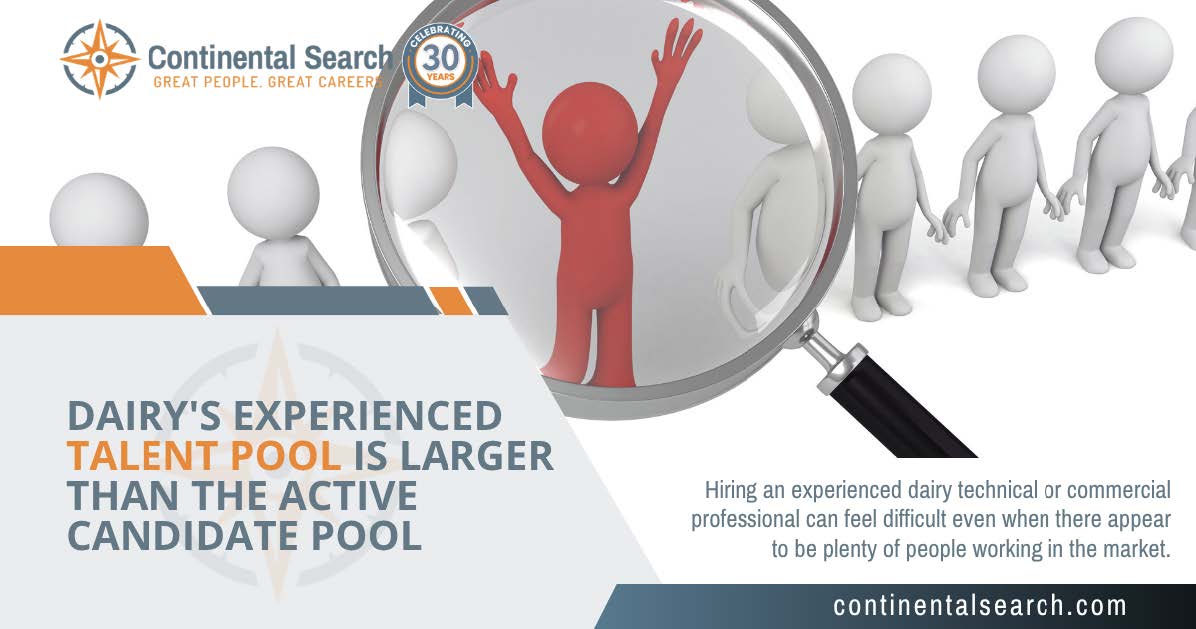
Hiring an experienced dairy technical or commercial professional can feel difficult even when there appear to be plenty of people working in the market.
Part of the reason is visibility.
Our 2026 Animal Health & Nutrition Technical Professional Salary Survey included 47 respondents whose primary species focus was Dairy, making Dairy the largest species group within Technical/Sales Support. Only three of those 47 respondents were actively seeking a new position.
That is an important distinction for employers.
A small number of active candidates does not necessarily mean there are very few qualified professionals in the market. It means many of the people a company may want to hire are already employed and are not actively looking for another job.
Recruiting them requires a different approach.
Most Experienced Dairy Professionals Are Already Working
The Dairy group included 33 solo contributors and 14 managers.
Among the 33 solo contributors, only two were actively seeking another position. One indicated that an increase of up to 10% could be enough to consider changing employers, while the other expected an increase of 11% to 20%.
Among the 14 managers, only one was actively seeking a new job. That individual indicated that an increase of up to 10% could be enough to consider a move.
Those numbers do not tell us that the other 44 respondents would refuse every conversation.
They tell us they were not actively trying to leave.
That matters when an employer builds a recruiting strategy.
If the search depends entirely on applications, the company is effectively limiting itself to the small portion of the market that has already decided to look.
The rest of the market has to be approached directly.
A Dairy Candidate Usually Has Something to Leave Behind
Experienced dairy professionals often build value over time.
A technical specialist may develop relationships with producers, veterinarians, nutritionists, dealers, consultants, or feed organizations.
A commercial professional may know the customers in a region extremely well.
A manager may have spent years building a team and establishing credibility inside the organization.
That accumulated value can make someone less willing to move casually.
A new job has to be compared with the position the person already knows.
That comparison includes compensation, but it also includes customer relationships, technical responsibility, leadership scope, travel, geography, management support, and the person’s confidence in the organization.
For the employer, that means the first recruiting conversation needs enough substance to justify a second one.
Compensation Can Make the Conversation More Complex
The Dairy responses also show a broad compensation range.
Among the 33 solo contributors, reported total taxable income ranged from less than $90,000 to $220,000 or more. Four reported $220,000 or more, while eight were in the $190,000-$219,999 range and another eight were in the $150,000-$169,999 range.
Across the entire Dairy Technical/Sales Support group, 23% reported total taxable income of $220,000 or more.
Those numbers should not be interpreted as a single Dairy salary benchmark.
The survey does not control for experience or tenure, and compensation in the report refers to total taxable income reported on a W-2.
The useful lesson is that people working in the same broad species category may have very different compensation depending on responsibilities and circumstances.
A hiring team should understand which type of Dairy professional it actually needs before comparing the position with a market number.
Define the Role Before Searching for the Person
Dairy searches can become narrow quickly.
A hiring manager may start with a request for someone who has the same title, comes from a direct competitor, works with the same type of customer, understands the same products, and already lives within the territory.
Sometimes all of those requirements are legitimate.
Sometimes several are preferences.
Before starting a search, I want to understand the work.
What does this person need to accomplish during the first year?
Who are the customers?
Is this primarily a technical role, a commercial role, or a combination?
How much travel is involved?
Will the person manage employees?
What authority will they have?
Does the position require an existing book of relationships, or can those relationships be built?
Those questions help separate qualifications that are essential from qualifications that simply make a resume look familiar.
That can materially change the size of the candidate pool.
Employed Candidates Need Specific Information
An actively searching candidate has already decided that something needs to change.
An employed Dairy professional may not have reached that conclusion.
That person needs to understand why the new position deserves attention.
A title and salary range are usually not enough.
Candidates want to understand the territory, customers, leadership expectations, travel requirements, resources, compensation structure, and how the organization defines success.
They may also want to know why the position is open.
Was someone promoted?
Did the previous employee leave?
Is the organization expanding?
Is the company rebuilding a territory?
Those details affect how candidates evaluate risk.
Good candidates can handle the realities of a position. Giving them accurate information early makes the conversation more useful for both sides.
Recruiting Beyond the Active Market Takes More Time
When only a small portion of a specialized market is actively searching, employers should expect outreach to take time.
People who are not job hunting may need several conversations before they are ready to decide whether the opportunity deserves serious consideration.
Some will decline.
Others will be interested but decide the timing is wrong.
A smaller group may discover that the new position addresses something they have been considering for months.
That is part of recruiting an employed market.
It is also why an employer should not wait until a position has been open for several months before deciding to approach passive candidates.
The Applicant Pool Is Not the Dairy Talent Market
The survey included 47 Dairy Technical/Sales Support respondents.
Only three were actively seeking another position.
For employers, that should affect how a Dairy search is planned.
The people applying to jobs are important.
They are not the entire market.
Many experienced Dairy professionals are already working, building customer relationships, managing teams, and developing careers inside organizations they know.
Reaching those people requires a clear opportunity, realistic compensation, and a recruiting process that gives them enough information to decide whether changing employers makes sense.
That is often where the strongest Dairy searches really begin.
Download your copy of the Salary Survey here: www.continentalsearch.com/ebook/2026-ahn-salary-survey/
Source: 2026 Animal Health & Nutrition Technical Professional Salary Survey, Continental Search
Rick Pascual
Practice Director | Ruminant & Swine Nutrition and Health
Continental Search
Rick@ContinentalSearch.com