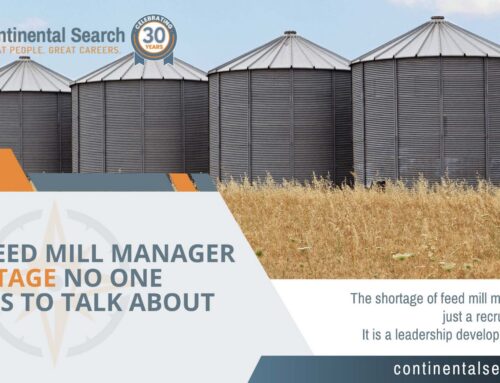
Some feed and grain companies assume a hard-to-fill mill manager role is just a market problem.
Sometimes it is.
- The candidate pool is tight.
- Strong mill managers are usually employed.
- Many are not actively looking.
- Relocation is harder than it used to be.
- Compensation expectations have changed.
- Rural locations can quickly narrow the field.
All of that is real.
But sometimes the role is harder to fill because the company has not made it recruitable.
That is a different issue.
A role can be important, necessary, and urgent, yet not attractive enough to attract the right candidate. Companies may believe they have a good opportunity, but the candidate sees it through a different lens.
They are asking:
- Whether the move is worth the risk
- Whether the company understands the role
- Whether leadership will support them
- Whether the whole situation makes sense for their career and family
If the answer is unclear, the search gets harder.
Making a mill manager role more recruitable does not mean pretending the job is easier than it is. It does not mean overselling the company or hiding problems. In fact, that usually backfires. Good candidates can handle reality.
What they need is:
- Clarity
- Support
- Fairness
- A reason to believe the opportunity is worth serious consideration
The first step is understanding what the role really requires. A feed mill manager is not just a production supervisor with a bigger title. That person is responsible for production, safety, quality, maintenance coordination, employee leadership, scheduling, customer expectations, inventory flow, cost control, and communication with senior leadership.
In many cases:
- They are also expected to improve the culture
- Develop future leaders
- Reduce turnover
- Help drive operational discipline
That is a lot of responsibility.
If the job description still reads like something written ten years ago, it may not reflect the actual role. Candidates notice when companies are vague or outdated.
They want to know what they are really walking into.
- What is the size and complexity of the facility?
- How many employees are involved?
- What are the production expectations?
- What are the biggest challenges?
- What support exists?
- What does success look like?
A role becomes more recruitable when the company can clearly explain it.
The second step is being honest about the facility. Every mill has challenges. Experienced candidates know that. They are not expecting a perfect operation.
What they are looking for is an honest picture.
- If maintenance has been stretched, say so. If staffing has been difficult, say so.
- If the team needs stronger leadership, say so.
- If the facility has had turnover, explain why and what the company is doing about it.
Some companies worry that honesty will scare candidates away. It may scare off the wrong candidates, and that is not always bad. The right candidate would rather know the truth early than discover it after accepting the role. A strong mill manager may be very interested in a challenging facility if they believe the company is serious about improvement.
The key is not whether the role has problems. The key is whether the company is prepared to support the person hired to solve them.
That leads to the third step: align responsibility with authority. One of the quickest ways to make a mill manager role less attractive is to give the manager full accountability but limited authority. Companies often want the manager to improve safety, production, staffing, morale, maintenance discipline, and costs. That is reasonable. But if every decision has to be approved elsewhere, the role becomes frustrating.
A strong candidate will ask about this, directly or indirectly.
- Can they make staffing decisions?
- Can they address performance issues?
- Can they influence maintenance priorities?
- Can they recommend capital projects?
- Can they change processes that are not working?
- Will leadership back them when tough decisions need to be made?
If the answer is no or unclear, the candidate may hesitate.
A recruitable role gives the manager enough authority to make a real impact. That does not mean unlimited control. It means the company understands that accountability and authority must align.
The fourth step is making compensation competitive before the search begins. Compensation is not the only thing candidates care about, but it absolutely matters. A company cannot expect to attract a strong feed mill manager with a package that does not reflect the role’s responsibility, location, complexity, and market demand.
This is especially true when relocation is involved. Candidates are not just comparing salary numbers. They are looking at the complete financial picture.
- Housing
- Mortgage rates
- Moving expenses
- Temporary housing
- Cost of living
- Spouse employment
- Schools
- Family disruption has become part of the decision
A modest salary bump may not be enough to justify the move.
Companies should be clear about compensation from the start. They do not need to lead with every detail, but they should know the range, bonus potential, benefits, and relocation support before they start interviewing. Waiting until the end to figure it out creates delays and doubt.
The fifth step is taking relocation seriously. Many feed mills are in rural or smaller communities. That can be a great fit for the right person, but it also means the company has to help candidates understand the area. Too often, companies provide plenty of information about the job and very little about the community. For a relocating candidate, the community is part of the offer.
- Housing availability matters.
- Schools matter.
- Spouse employment matters.
- Healthcare, churches, recreation, cost of living, and distance from family all matter.
The candidate may be excited about the role and still decline if the move does not work for the household.
A company can make the role more recruitable by:
- Preparing community information
- Offering house-hunting support
- Discussing relocation assistance early
- Being flexible on the start date when possible
- Understanding that the decision involves more than the candidate alone
Relocation should never be treated as an afterthought.
The sixth step is improving the interview process. Strong candidates pay attention to how a company recruits.
- If communication is slow
- Interviews are poorly organized
- Decision makers are not aligned
- Feedback takes too long
The candidate begins to question the opportunity.
The process becomes a preview of what working for the company may feel like.
A recruitable role needs a professional hiring process. The company should know who is involved, what each person is evaluating, what the timeline looks like, and who has final decision authority. Interviewers should understand the role. They should be prepared to answer questions honestly. The company should follow up when it says it will.
This sounds basic, but it matters.
Good candidates are not just being interviewed. They are interviewing the company.
The seventh step is showing a future. Strong mill managers want to know whether the role leads somewhere. That does not always mean a promotion in two years.
It may mean the chance to:
- Improve the facility
- Develop people
- Participate in capital projects
- Take on broader responsibility
- Build a stable, long-term home with the company
If the role feels like nothing but constant firefighting, it becomes harder to recruit.
- Candidates want to know there is a reason to invest their time and reputation.
- They want to know whether the company values the role and considers the mill important to the business.
A good candidate may accept a challenge. They are less likely to accept a dead end.
The eighth step is supporting the current team. Candidates will want to know what kind of people they are inheriting.
- Is there a strong assistant manager?
- Are supervisors dependable?
- Is maintenance capable?
- Is turnover under control?
- Are there chronic performance problems?
- Has the company avoided difficult personnel decisions?
A mill manager role becomes more recruitable when the company can show that the new leader will not be walking into total disorder without support. If there are team issues, be honest about them. But also be clear about how the company will help address them.
The ninth step is protecting the role from becoming impossible. Some companies quietly allow the mill manager position to become the place where every unsolved problem lands.
- Production issue? Give it to the manager.
- Staffing problem? Give it to the manager.
- Safety concern? Give it to the manager.
- Maintenance conflict? Give it to the manager.
- Customer issue? Give it to the manager.
- Corporate reporting needs? Give it to the manager.
At some point, the role becomes too heavy.
Companies need to look honestly at workload, reporting expectations, staffing levels, administrative burden, and support structure. If the manager is expected to be everywhere, solve everything, and absorb every problem, the job may not be sustainable for long. It may also become difficult to retain the person after they are hired.
Making the role recruitable means making it sustainable.
Finally, companies need to present the opportunity accurately. Not perfectly. Accurately.
A strong candidate wants the truth: the good, the bad, and the path forward.
- They want to understand why the company is worth joining
- Why the role matters, what problems need solving
- What support will be there
A mill manager role becomes more recruitable when the company can say,
- Here is what we need
- Here is where we are strong
- Here is where we need improvement
- Here is how we will support the person who steps into this seat
That kind of honesty stands out.
The market for strong mill managers is not easy.
- Companies cannot control every factor.
- They cannot create a deep candidate pool overnight.
- They cannot make relocation simple for every family.
- They cannot remove every challenge from the facility.
But they can make the role clearer, more realistic, better supported, and more attractive to the right person.
That is what recruitable means.
Not easy.
Worth considering.
Jim Hipskind, CPC
Director of Executive Search – Agribusiness
Continental Search
jim@continentalsearch.com
(517) 648-9314