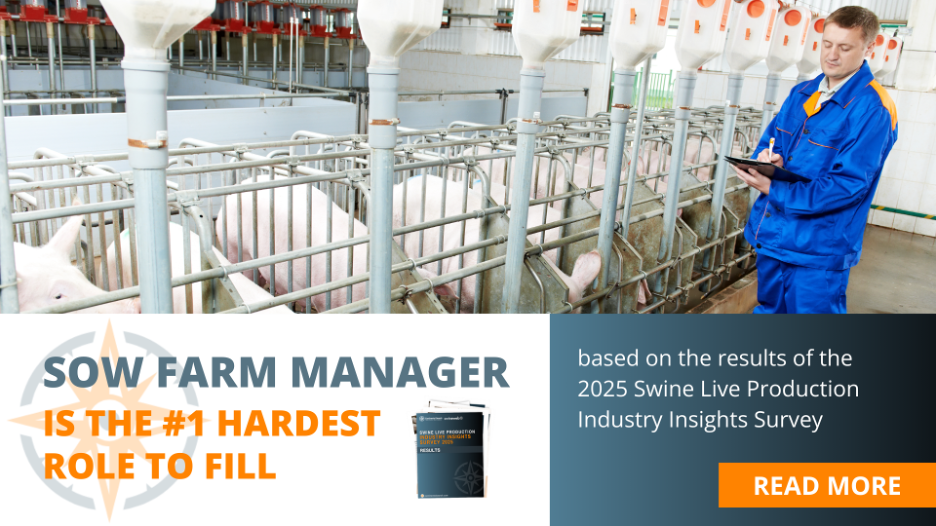
It ranked highest at 40.28% (29/72), ahead of Dept/Assistant Manager (31.94%).
I’ll be honest: I didn’t expect this.
I created this survey quite confident that sow farm managers would not rank as the hardest or longest role to fill. In the past, I’ve filled Sow Farm Manager roles in as fast as two weeks.
Two weeks!
So if you asked me a year ago which swine live production role would be the toughest to fill, I would’ve said nutritionists or veterinarians without hesitating. That’s why our latest Swine Live Production Industry Insights Survey caught me off guard. The role that surfaced as the #1 hardest and #1 longest to fill wasn’t a technical specialist role at all; it was, surprise, surprise, the Sow Farm Manager.
However, sow farm managers also showed up as the role most often filled through internal promotions and most often hired from competitors. That sounds contradictory. If companies are promoting people into the role, why is it still the hardest to fill? And if companies are hiring Sow Farm Managers from competitors all the time, why does it still take so long?
Lastly, when respondents were asked why it takes so long to fill the most difficult roles, the #1 answer, by a mile, was “Limited qualified candidates available” (69.44%). I know that question wasn’t exclusive to sow farm managers, but given that Sow Farm Manager is also the role most often named as the longest to fill, it’s hard not to read that result as heavily pointing toward this role.
With all these contradicting results in this survey, it got me thinking about what is happening. Is the bench really thinner than anyone, including myself, wants to admit?
Why Sow Farm Managers Are Hard to Hire
I’ve only been recruiting for two years. And even with just that, it’s easy for me to see why Sow Farm Manager is a must-have role, and why that alone can create constant pressure in the market. You can’t leave sow farm leadership empty for long. The operation won’t wait, and numbers won’t pause. The team still needs direction. So when that seat opens, everyone scrambles to patch the same hole, fast.
That’s the simplest reason it’s hard to fill: it’s a role the business can’t function without. When demand is constant, even a decent talent pool starts to feel small. And if the survey is right, if qualified candidates really are limited, then it’s pressure with scarcity.
Internal Promotions vs. Competitor Poaching
Now add internal promotion into the mix, and the picture gets clearer. If you can’t reliably hire sow farm managers from the outside, the logical move is to promote from within. It’s faster and safer. The person already knows the operation, the people, the expectations, and the rhythms of the farm. That’s probably why sow farm managers show up as the role most often filled through internal promotions.
But internal promotion doesn’t automatically mean “the pipeline is healthy.” Sometimes, the role is so urgent that you can’t wait for the perfect external match. You promote the best available person because you need a leader in the seat—now.
And the moment you promote someone into a sow farm manager role, you’ve basically created a verified candidate for the rest of the market. And that’s when competitor hiring starts to make perfect sense. Because if you’re another employer who needs a sow farm manager and your own internal bench isn’t ready yet, the fastest shortcut is to recruit the finished product from someone else.
These are only theories, but these are why the same role also shows up as the one most often hired from competitors.
The more I sit with it, the less it feels contradictory and the more it feels like a loop. The industry is basically manufacturing its own poaching targets. You promote because you have to, then you lose people because others can offer a better deal, a better schedule, a better location, or just a change. Then you’re back in the market again. And because everyone is doing the same thing at once, promoting internally and poaching externally, the same names circulate.
Why This Looks Like a Leadership Bottleneck
It starts to look like there are plenty of sow farm managers out there because you keep hearing about movement. But this movement is just what scarcity looks like under pressure.
And that brings me back to the question I can’t stop thinking about: maybe the bench really is thinner than we want to admit. Maybe the industry isn’t short on people who can work in swine, but it is short on people who can lead sow farm operations sustainably, long-term, without burning out or getting pulled away.
If you’re an employer reading this and you’re seeing the same thing on your end, I’d love to talk. There are more findings in the Swine Live Production Industry Insights Survey that put context around this: what’s driving delays, what’s pulling leaders away, and what employers can do to compete without just overpaying and hoping for the best.
If you want the full survey results, email me at Cris@continentalsearch.com. I’ll send the full report over. And if you’re hiring for sow farm leadership right now (or trying to retain it), I’m happy to compare notes and share what we’re seeing across the market.
About the Author
Cris Soronio joined Continental Search in 2023 as a Talent Scout and was the first one from her batch to receive a Revenue Generator award. Five months later, Cris was promoted to Recruiter and has been connecting top talents in swine live production roles in the US and Canada with leading organizations in these sectors.