From Ecuador to the U.S. pork industry, she built her career by learning every part of the job and leading with calm authority.
By Cris Soronio
When I called Alina Porta for this interview, she was driving home from a site visit on a Friday afternoon. That felt fitting. Her career has been built in motion. She goes where the work is: farms, plants, audit sites, hard conversations, and problems that cannot wait.
For this first Women in Swine feature, I wanted to start with a woman whose story feels true to the swine industry. Alina knows that some of the hardest parts of the job can show up before the real work even starts.
Alina may be there to review animal welfare, walk through an audit, talk about biosecurity, or address a problem that could affect pigs, people, or the brand. But before the conversation gets going, some people have already made an assumption.
Alina is a woman. She is Hispanic. She is five feet tall.
She knows that in some rooms, she will have to earn trust before she can even get to the issue.
Then she starts talking.
She explains what she sees. She connects it to the standard, to the customer, to the pigs, and to the responsibility the industry carries. She comes in prepared, rather than trying to overpower anyone. By the end of the visit, the same people who seemed guarded at the start are usually engaged. Sometimes they are even smiling.
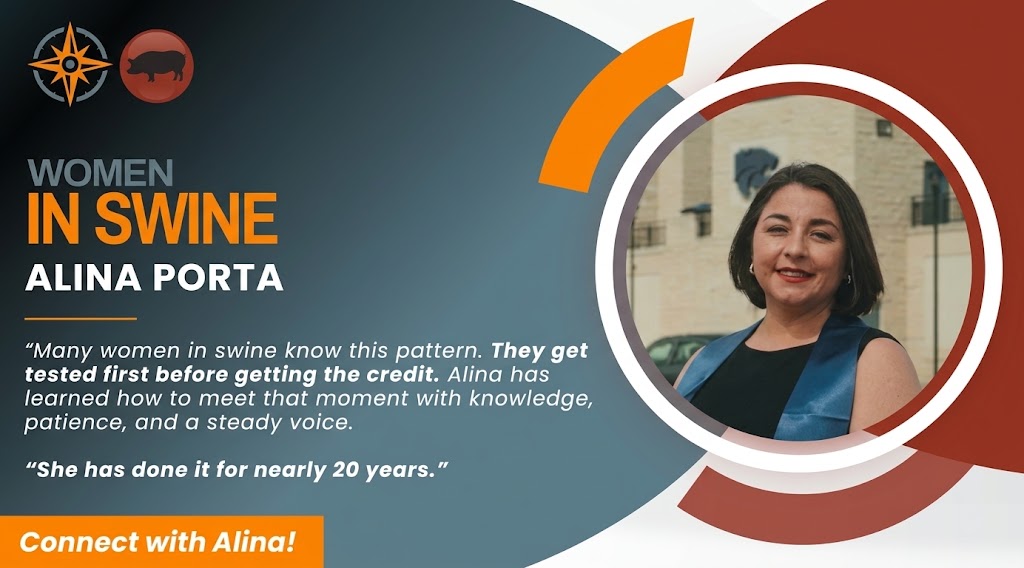
Many women in swine know this pattern. They get tested first before getting the credit. Alina has learned how to meet that moment with knowledge, patience, and a steady voice. She has done it for nearly 20 years.
Alina grew up in Ecuador on a small farm. Agriculture was never a casual interest for her. She told me that by the time she was about 10 years old, she already knew she wanted to work with animals and plants. At 15, she enrolled in a technical high school focused on agriculture. She wanted to prove to her parents that this was serious. That it was the direction she wanted for her life.
That early commitment led her to Zamorano in Honduras, where she earned her undergraduate degree in Animal Science and Agriculture in the Tropics. At that stage, swine was not yet the plan. Her thesis work was in sugarcane, and she thought her path might stay on the plant side of agriculture.
Then an unexpected opportunity changed her direction.
In 2006, Smithfield, then Murphy-Brown, recruited at Zamorano. Alina was one of the students selected. She came to the United States in February 2007. She still remembers the date clearly. She arrived ready to work and ready to learn something completely new.
Her first job was direct farm work. She was on a sow farm in the farrowing department, processing pigs and feeding animals on a site with about 1,000 sows, plus nursery and finisher space. That kind of start teaches things no manual can. It teaches rhythm, responsibility, and how much it depends on people doing the basics well every single day.
After a little more than a year, she was promoted to farm manager on another farm in North Carolina. She built her career by taking the hard jobs first and learning from them.
That approach shaped everything that came next.
Over the years, Alina has worked as a farm manager, production manager, auditor, and now animal welfare coordinator. Before joining her current company, she worked with Cloverleaf Animal Welfare System, an international animal welfare and compliance company. There, she collaborated with producers and professionals across the swine industry and conducted audits across a wide range of pork production systems in Mexico, Europe, and the United States, including small commercial farms, show pig operations, and large-scale commercial farms.
This experience gave her a broader perspective on U.S. pork production and showed her that there is not just one way to run a pig operation. Today, she works in animal welfare and compliance for Wholestone Prestige. She helps make sure producers stay current on PQA and TQA. She conducts Common Swine Industry Audits. She works with livestock teams, procurement, plant operations, and producers when issues come up that could affect welfare, product integrity, or customer confidence.
She also leads a critical part of foreign animal disease preparedness across two facilities. If a disease such as African Swine Fever ever reaches the United States, readiness will matter long before the first crisis meeting starts. Biosecurity has to be real, not just written down. Plans have to work. Teams have to know what to do. Alina is one of the people helping make sure that preparation is in place.
What stands out to me is how much ground she has covered. Some people spend their careers in one part of the business. Alina has worked from farm to plant. She has managed people, audited systems, and handled communication between producers and internal teams. That gives her a view that is both broad and practical. When she speaks, she is drawing from more than one chapter of experience.
Still, experience does not remove every obstacle.
When I asked her what feels most challenging, she answered directly. As a woman in swine, especially in leadership roles, she has often had to prove herself in male-dominated spaces. In some settings, that means pushing for changes that others do not want to hear, like building a disinfection station or correcting a site issue that has gone unaddressed. In other settings, it means walking into a farm where an older producer looks at her and silently wonders why he should listen.
Alina knows that reaction. She has lived it more than once.
What I appreciated was the way she described her response. She does not try to shame people nor walk in defensive. She explains the why and connects it to what producers are being asked to show customers and to what the industry owes the animals in its care. She also brings her own background into the conversation. Once people understand that she has spent almost 20 years in swine and has worked across production and auditing, they listen differently.
She shared one example that stayed with me. Sometimes she points out a hole or a facility issue that the farm team no longer notices because they see it every day. She calls attention to it early, before it turns into a bigger problem. That practical approach usually shifts the conversation. The audit may still reflect missed points, but people leave with a clearer understanding of what needs to be fixed and why it matters.
That says a lot about how trust actually works in this business. It grows when people know you understand the job and can feel that you are there to help them protect it.
Her leadership style follows the same pattern.
“I always lead by example,” she told me. “I’ve never sent someone to do something that I don’t know how to do.”
She believes expectations should be clear from the start. That people need to see the standard in action, not just hear it in a meeting. And she believes mistakes are part of training. In swine production, people learn by doing, and she leads with that in mind.
Alina kept building her own skills the same way. She earned a master’s in agribusiness from Kansas State University, which helped strengthen her business thinking, communication, and presentation skills in English, her second language. She also participated in the Pork Leadership Institute, which gave her a wider view of how connected the U.S. pork industry really is. The industry is large, but the people in it are closely connected.
When I asked what younger people need if they want to enter swine today, her answer was simple: “Be humble.”
I liked that answer because it is honest. A college degree can open a door, but it does not remove the need to learn from the people around you. Alina believes young people should be willing to do chores, ask questions, and learn from anyone who knows the work, even if that person does not look like them, speak like them, or hold the same title. She also believes they need to keep learning long after school. Research changes. Laws change. Technology changes. If you stop paying attention, you fall behind.
And there is a lot changing right now that excites her. She talked about more science-based feeding in sow farms, improvements in genetics and reproduction, new wet feeders in finishers, and technology that lets teams monitor barns, ventilation, feeders, and records from a phone. She remembers when so much had to be written on paper, and every power issue meant an immediate drive to the farm just to start troubleshooting. She still believes in being present, but she also sees how better tools can help people respond faster and care for pigs more effectively.
For all that progress, she is clear about what still needs to improve.
Alina sees more women working on farms now than when she started. That is good to see. What she does not see enough of is women in upper management. She told me she can count the number of women directors of operations she knows on one hand. She has felt that gap herself. In one role, she believed she was the most qualified person for a promotion based on her background and credentials. The job went to a man who lacked the same qualifications.
She talks about that calmly. The facts are enough.
It would have been easy to let that experience harden her, but she chose to keep preparing and learning. She kept working toward the level she knows she can reach.
And she knows exactly what that next level is.
Alina lives in Omaha now with her husband and children. The move was tied to her husband’s role, and that is part of why she stepped away from production and into her current plant-side job. She speaks about that decision clearly. It was a family commitment. But she is just as clear about what she wants next. Her passion is still production. She wants to return to a production-facing leadership role. Her goal is a director of operations position, either on the sow side or in finishers. She would love to go back to North Carolina one day, though she knows many of the biggest opportunities may be in the Midwest. She said it plainly: she knows she is capable of the role.
In many workplaces, women still feel pressure to soften their ambition. Alina does not do that. She has done the work, built the experience, and earned her place in the conversation. She knows the role she wants next, and she is ready for it. Alina has earned the right to say exactly what she wants.
She also has not lost her belief in swine. She told me she has never looked for a job outside the industry. She is passionate about pork production. You can hear it when she talks about animals, farms, teams, and the future of the business. Even now, in a role outside day-to-day production, that is still where she feels most at home.
When I asked what advice she would give her younger self, her answer was simple: “Don’t be afraid. It is possible.”
That line stayed with me after our conversation. It speaks to young women entering the industry and to those who have been in it for years, still working toward the opportunity they know they are ready for.
For this first Women in Swine feature, I wanted to start with someone who has built her career one role at a time and never lost sight of where she wants to go. That is Alina Porta. She learned the work early, stayed committed to the industry, and earned trust across every role she took on. Her story will feel familiar to many women in swine and encouraging to those still finding their way.
About Cris Soronio
Cris Soronio is the author and the woman behind “Women in Swine”, created in collaboration with SwineWeb. She is the Lead Recruiter for Swine Live Production at Continental Search, where she works closely with producers and leaders across the industry to connect great people with great operations. Cris is also passionate about supporting the next generation of women in swine—and helping make sure the stories that shaped this industry continue to be shared.