Cris Soronio
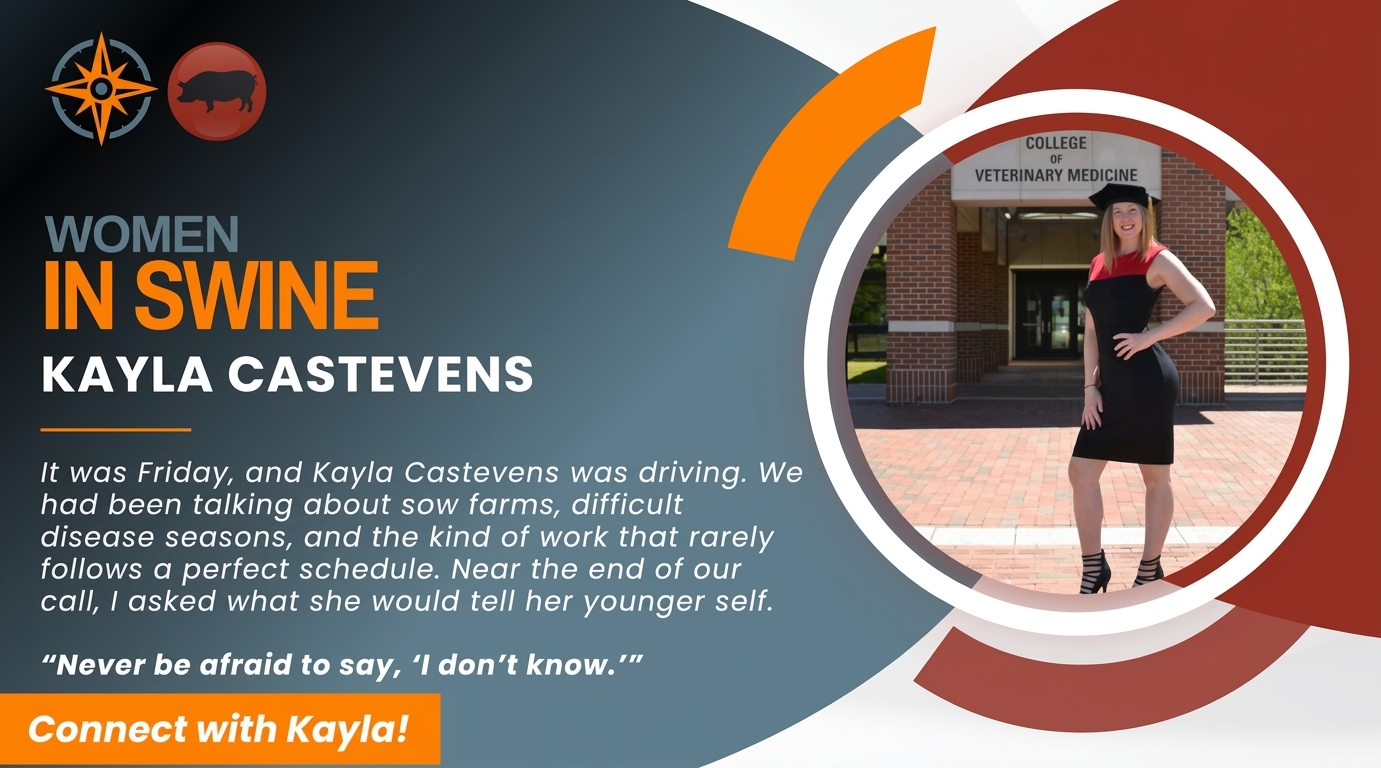
It was Friday, and Kayla Castevens was driving. We had been talking about sow farms, difficult disease seasons, and the kind of work that rarely follows a perfect schedule. Near the end of our call, I asked what she would tell her younger self.
“Never be afraid to say, ‘I don’t know.’”
Young veterinarians face many firsts, Kayla explained. “Probably 90% of the time, you are not gonna know” when you’re starting out. The honest response is to admit it, make a few calls, look for the answer, or learn alongside the people who asked.
Kayla’s answer fits the career she described. She oversees herd health across farms in more than one state and has helped teams through disease elimination, herd closures, program changes, and long seasons when several problems arrived close together. None of the responsibility has convinced her that a veterinarian should pretend to know everything.
In swine, she said, diseases do not always read the book veterinarians studied in school.
Before Pigs, Almost Every Other Animal
Kayla grew up in rural Western North Carolina on a small hobby farm. Her family had horses, bottle calves, goats, backyard chickens, and other animals. Cattle operations surrounded them. Farm life was ordinary, and veterinary medicine became her plan early.
During her sophomore year of high school, she externed at a local mixed-practice veterinary hospital. The externship became a job, and the job lasted about ten years. She worked there through high school, then traveled home on weekends while completing her undergraduate degree.
Pigs were the exception in her childhood. She had little experience with them until she studied animal science at North Carolina A&T State University and worked on the university farm. Its indoor and outdoor swine operations gave Kayla her first real job with pigs.
She entered veterinary school at North Carolina State University in 2016 with broad large-animal interests. Horses had held her attention for years. During her first summer, she joined the school’s swine professor on an anemia research project. The work sent her to several farms and gave her more time around pigs than she had ever spent before.
“I really, really fell in love with the pigs and kind of never looked back,” she said.
Veterinary school supplied the science, but commercial swine production demanded another education. Kayla remembers receiving limited swine instruction beyond diseases and basic concepts. Externships, research projects, and time with different companies showed her how farms actually operated.
“Learning for a swine vet truthfully starts after you graduate,” she said.
Good mentors helped when she joined Country View. So did the network she had begun to build as a student. Kayla found veterinarians inside and outside the company whom she could call with a problem. Programs such as BI’s DVM Swine Academy and the AASV Early Career Program supported by a USDA grant, introduced her to other young professionals who were working through many of the same questions.
Their conversations remain useful: What are you seeing? How are you handling it? What worked? What failed?
No one else can make the final decision for her, but their experience gives her more information before she makes it. Kayla also accepts that a sound decision can change. New research, disease knowledge, and technology may produce a better approach five years later.
She sees promise in technology for animal counts, disease detection, behavior monitoring, audits, and compliance. Farms, however, differ in layout and needs. New systems must work under real farm conditions and at a reasonable cost. Curiosity gets the idea through the door; practicality decides if it stays.
The Work Starts at Farm Level
Most mornings, Kayla visits one or two farms, usually sow farms. Afternoons often bring email and office work, plus anything unexpected that followed her out of the barn.
“You kind of never know what’s going to happen even when you have a plan,” she said.
Her role covers health management for Country View’s North Carolina systems. Kayla also holds responsibilities in Pennsylvania, where many of the pigs are weaned, and travels there about once every six weeks for a week at a time.
Animal health is only part of her day. She works on welfare and biosecurity, trains farm teams on marketing programs, and helps with production and compliance. Country View’s North Carolina employee group is relatively small, while its farms there operate under contract. The structure gives Kayla a wider range of work and a close view of how departments depend on one another.
Disease season brings the hardest days. Kayla spoke about a difficult winter, several disease challenges, and the pressure of making program changes at the same time. She has also guided farms through multiple herd closures and disease-elimination efforts during her years with Country View.
The reward comes later, when a farm reaches a level of health it may never have experienced before. Performance improves. People who carried the plan through become more capable and confident. Kayla sees both outcomes.
Her North Carolina team has become a family. A problem belongs to the group, and so does the work required to reach the other side. Faith gives Kayla another source of steadiness. She believes hard experiences often carry a lesson, even if the reason takes time to become clear.
Kayla’s leadership becomes most visible beside the farm team. Many managers have worked with her for five or six years. She remembers their vacations, asks about their children, and checks on events they mentioned during an earlier visit. The relationship has room for life beyond the farm.
When a major change begins, Kayla tries to show up. She explains the plan, demonstrates the work, and helps the team start. During a crisis, she stays close.
“Being there, doing the work with them,” she said.
Technical knowledge carries more weight when people trust the person offering it. Kayla also wishes she had studied Spanish earlier. In her own work, she has seen how shared language can make it easier to explain a health plan, raise a concern, and discuss what people see in the barn. Her remark sounded lighthearted, but the lesson underneath is serious.
Making Sure Women Are Heard
Swine remains male-dominated, though Kayla has seen more women on farms and in leadership than she did five years ago. Progress depends on the company and the part of the industry.
Gender has not been a major obstacle in her current role. Kayla calls herself headstrong, with a dominant personality that can power past resistance.
But her experience has not kept her from seeing what happens to other women.
She has watched a woman raise the same idea many times without a response. A male colleague later offers it, and suddenly the room considers it a good idea.
Some of Kayla’s colleagues eventually left the industry because they did not feel heard or respected.
Keeping talented women will require more attention to pay, maternity leave, and work-life balance. Kayla believes women should be able to become mothers, return to work, and maintain the careers they built. And the industry will face the question more often as women continue to enter veterinary medicine and farm leadership.
“We need to figure out how to navigate it so that we can keep all these wonderful women,” she said.
Kayla plans to stay close to farm-level work, where she can remain involved with animals and people. She also wants to understand more of the business beyond the farm: the financial decisions, other departments, and the full path through production. A wider view, she believes, will improve her recommendations and help her see where each farm decision leads.
Across research farms, sow farms, and disease challenges, the same idea has followed Kayla: stay open, remain flexible, and ask for help.
Her “I don’t know” is never the end of an answer. A phone call follows. Then a question, a search, or a conversation with someone who has seen the problem before. Kayla keeps working until she can return to the farm with something useful.
For a veterinarian, that may be one of the most honest forms of confidence.