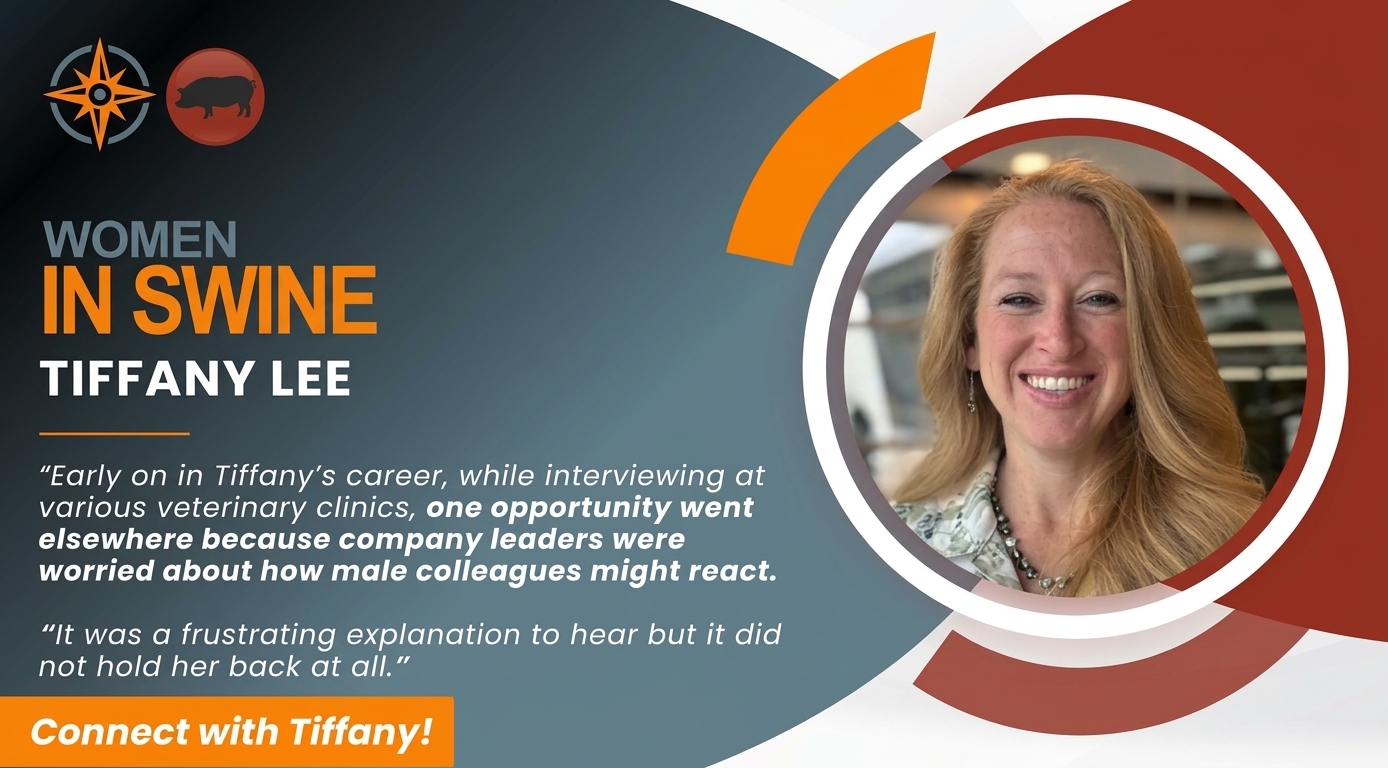
“Tiffany Lee stepped into the swine with honest questions and a willingness to learn. This shaped her career then, and it still shapes the way she leads now.”
By Cris Soronio
Why do we do it this way?
Tiffany Lee has built a career around that question. It took her from a small farm in Kansas into veterinary medicine, then into research, meat industry work, swine, and now a leadership role that spans animal care, compliance, and sustainability.
In her hands, curiosity is practical. It helps her learn quickly, and it pushes teams to take a closer look at routines that may no longer deserve autopilot.
Agriculture was already part of her life in eastern Kansas. Her family farm raised corn, soybeans, wheat, hay, and straw. Cattle and pigs were also part of the operation, along with chickens and the usual mix of animals that come with a small, diversified farm.
The scale was modest, but the exposure was wide. Farm work gave her an early feel for livestock, seasons, and responsibility.
By the time she was seven, Tiffany already knew what she wanted to do—veterinary medicine. Kansas State carried her through undergrad and veterinary school, and she graduated in 2012.
Mixed animal practice in eastern Colorado came next. Much of that work centered on beef cattle, with some feedlots, ranch horses, and companion animals as well. Practice was a good fit in many ways, especially because she enjoyed working with clients.
Even so, the bigger agricultural picture kept pulling at her. She wanted to contribute beyond one case at a time.
Tiffany returned to Kansas State for a PhD focused on beef cattle welfare at slaughter facilities. The work centered on incoming cattle and the welfare side of that transition into harvest. It also brought her closer to the point where animal care, operations, and public expectations all meet.
Before finishing the degree, the North American Meat Institute hired her as Director of Regulatory and Scientific Affairs. She moved to Washington, D.C., started the job, and finished the PhD while working full time. The workload was heavy, but the experience widened her view of agriculture and food production.
A call from Clemens Food Group brought swine into sharper focus. The role was director of animal care and compliance.
Tiffany was straightforward about the gap in her background. Swine welfare on the plant side was familiar, but commercial swine production was still new territory.
Yet Clemens saw value in that outside perspective. Someone new to the system often notices what others no longer question.
And so curiosity became one of her strengths in the role. Tiffany asked why a process existed, why a certain step had become routine, and whether the original reason still held up. Those questions helped her learn quickly. They also gave teams room to examine habits that had been running on momentum for years. In a technical business, a respectful outsider can sometimes move improvement along faster than someone who has always worked inside the same pattern.
Today, Tiffany serves as Executive Director of Sustainability. Much of her time still sits with animal care and compliance, while the rest focuses on sustainability work across the company.
Marketing programs and label claims are part of the job. Animal welfare audits, staff training, and customer education are part of it, too. Sustainability adds another layer, with attention on long-term efficiency and improvement across the operation.
Her calendar reflects this wide scope. Kansas is home, but much of the month happens on the road. One week often goes to company headquarters for meetings with leadership, sales, FSQA, plant teams, and other groups across the business. Other weeks take her to farms and facilities in Pennsylvania, Indiana, North Carolina, and beyond.
Time in barns, audits, training sessions, and cross-functional problem solving all show up in the same month. Some conversations stay focused on pigs and welfare. Others move into plant operations, customer expectations, or broader business priorities.
Customers are part of the job as well. Tiffany helps them understand how pigs are raised, how welfare is managed, and why certain production practices are in place. Trust is built through understanding. When customers know how a company operates and why, the relationship changes. The industry benefits when more people can see the work clearly instead of guessing at it from the outside.
Tiffany told me that the most rewarding part of her job is also the most challenging: working with people.
Team growth has been one of the most satisfying parts of the last five years. Watching people learn, gain confidence, and handle more complex work carries real weight. The harder side shows up in tough conversations, misaligned priorities, and the normal friction that comes when multiple departments are trying to solve the same problem from different angles.
And clarity matters a lot in those moments. Tiffany leads with transparency and direct communication. Her goal is alignment. People need to know where the work is headed, why it matters, and how the team plans to move forward.
A direct style can make some conversations less comfortable, but it usually saves time and confusion later. In animal care, compliance, and operations, vague language has a way of creating bigger problems.
Communication, in her view, also has to fit the room. Some team members speak English as a second language. Some understand the daily work deeply but rarely use technical vocabulary. Some topics are simply hard, especially when health, welfare, compliance, or sustainability are involved.
Tiffany pays attention to that and adjusts her approach. Instead of stopping at “Does that make sense?” she asks people to walk through the process, explain it back, or connect it to their daily job. Good training often looks like a conversation.
Formal education gave her a strong foundation, but it is only part of the story. Tiffany spoke openly about setbacks and failures, and she sees those moments as some of the best education she has had.
Hands-on experience matters just as much. People who work with pigs every day often carry practical knowledge that no degree can replace. Farm staff, animal caretakers, and managers have all taught her important lessons over time. Respect for that kind of knowledge comes through clearly when she talks about the industry.
Her advice to people entering swine reflects the same mindset. Stay open to opportunities. Expect a period of discomfort. And keep adding skills, even when they sit outside your current job description.
Tiffany mentioned taking HACCP training as one example. It may not sit in the center of her role, but it helps her understand more of the business and makes her more useful when problems cross departments. Careers often grow that way. One new skill broadens the view. A broader view usually leads to better decisions.
Swine keeps her interested because the industry is willing to evolve.
Tiffany sees producers who pay attention to what consumers want and who are generally open to change when the change improves the work. Technology will play a big part in that future. Consumer demand will shape it too. She also sees room to improve the eating experience itself, including the balance between lean and fat in pork products.
Her view of the industry is wide, which makes sense for someone whose work touches production, plant operations, customers, and sustainability.
Women in swine have more room today than they did years ago, and Tiffany sees that clearly.
More women are coming on farm as subject matter experts, and more people are listening. Progress, though, has not removed every barrier.
Work-life balance still lands unevenly in many homes, especially for working mothers. Tiffany framed that issue in a thoughtful way. Real equality depends on more than asking women to do more. It also depends on giving men the same expectation to carry responsibilities at home. Culture shapes opportunity as much as policy does.
Bias has touched her career as well. Early in her career, while interviewing at various veterinary clinics, one opportunity went to another candidate because company leaders were worried about how male colleagues might react. It was a frustrating explanation to hear, and smaller moments can wear on a person, too.
Many women know the feeling of making a point in a meeting and watching it land differently than it should. Tiffany’s response has been steady over time: stay professional, stay direct, and keep moving toward places that value the work you bring.
Her advice to her younger self is probably useful for more than one generation.
You are not going to know everything. Ask questions sooner, accept failure earlier, learn from it, and move forward.
The perspective fits the path she has taken. Veterinary medicine led to practice. Practice led to research. Research led to regulatory work. Regulatory work opened the door to swine. Swine led to broader leadership in sustainability. Growth came from staying open, learning fast, and continuing to ask good questions.
Looking ahead, Tiffany wants to help make small changes inside her company that can influence the industry at a larger scale. Welfare practices, operational standards, and practical improvements are part of that goal.
The scale may start small, but strong ideas tend to travel when they work well in real life. A better process, a clearer standard, or a more useful way to train people can shape more than one site over time.
This series is built to highlight women whose work strengthens the swine industry in real ways.
Tiffany’s story is a good one for women entering swine, especially those who feel pressure to have every answer before they take the next step. It is also a strong example for women already in the industry who are growing into bigger roles and learning new parts of the business as they go.
Her career shows the value of asking clear questions, learning from the people closest to the work, and staying open to roles that may look unfamiliar at first. The result is a career built on range, credibility, and steady improvement. Swine needs more of that, and Tiffany is already bringing it.