By Cris Soronio
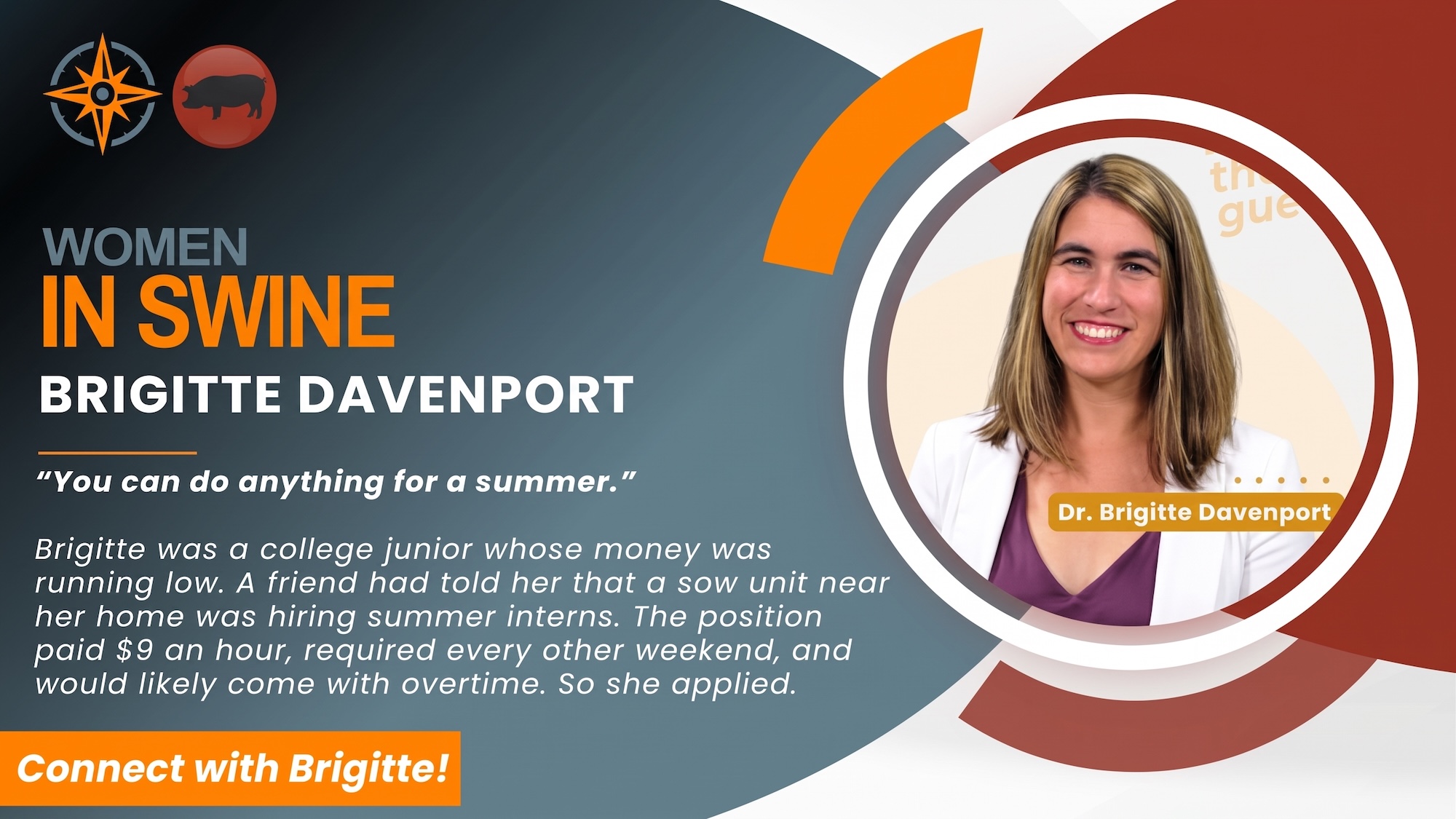
“You can do anything for a summer.”
Brigitte was a college junior whose money was running low. A friend had told her that a sow unit near her home was hiring summer interns. The position paid $9 an hour, required every other weekend, and would likely come with overtime. So she applied.
Pigs were still new to her. Brigitte had grown up active in 4-H, where horses took most of her attention. She competed at state and national levels and completed projects in veterinary science and animal science. Swine entered the picture later, through a production management class at Southern Illinois University in Carbondale.
But the subject felt different, and she liked it. A summer job suddenly seemed manageable.
Almost 15 years later, Brigitte is still working with pigs.
The student who once wondered what she could do with an animal science degree is now Director of Sows for Country View Family Farms’ Indiana region.
Her career has included field veterinary work, production management, senior veterinary responsibilities, and leadership across a part of the business where health challenges can quickly change the year’s plan. Brigitte still cares about results. Much of her attention now goes to the people responsible for reaching them.
The Summer That Changed Her Direction
Brigitte entered college as an animal science pre-vet student, partly to keep her options open. She did not begin with a firm plan to become a veterinarian. Her four years included work at a humane shelter, time on the equestrian team, and several animal-related experiences.
The summer at the swine unit gave her something the classroom could not. She enjoyed the daily work enough to find another swine job during her senior year, this time in a research barn. An internship followed. So when friends began applying to veterinary school, Brigitte applied to the University of Illinois and was accepted.
Her decision had become clear by then: if she was going to become a veterinarian, she wanted to work with pigs.
Brigitte searched for a swine position before she graduated in May 2016. She contacted people in the industry, told them she hoped to work on the East Coast, and asked for recommendations. A mentor pointed her toward an opening at Country View Family Farms. The company offered her a field veterinarian role in January, and she started in May.
And she has stayed with Country View ever since.
Each role expanded her view of production. Field veterinary work put her close to herd health. A production manager position added operational responsibility. Later, as a senior veterinarian, she brought both sides together. Her current role asks her to think about weaned pig volume, cost, and the next group of farm managers, leads, and assistant managers.
Today, people development is the hardest part of the job, Brigitte said. The work is also the most rewarding.
“It’s intentional, and it takes a lot of time,” she said.
A leader cannot set aside two hours, complete the assignment, and declare someone ready. Growth needs attention every week. Rushing the process may check a box, but the result rarely holds up. Brigitte sees the payoff when employees reach their goals, improve their performance, and begin to recognize their own ability.
Their progress strengthens the operation and gives people a reason to reach for more.
When the Goal Has to Change
Brigitte describes herself as goal-driven. On a difficult day, the goal may be no larger than finishing her to-do list. At the regional level, the numbers are bigger: weaned pig volume, cost, and year-over-year improvement.
But her Indiana region has faced serious health pressure. One recent year became difficult almost immediately. By the first week, Brigitte knew some annual targets were no longer realistic because of the health challenges already in front of the team.
Even then, the work had to move forward.
So she looked for smaller successes that could keep people connected to the larger purpose. The team could learn from the hard year, finish it with discipline, and create a better start for the next production cycle. Goals still mattered, though success needed a more honest definition.
Her willingness to reassess a difficult situation came from experience. About six months after veterinary school, Brigitte faced a health problem in which she did not yet know all the questions to ask. A sow unit later broke with disease.
Looking back, she can name what was missing: better questions, the right resources, and enough time to understand the full situation. This experience changed how she approaches problems now.
She slows down, asks more, and looks beyond the first answer.
The lesson also shapes her advice to new professionals. A drive for knowledge matters, and webinars, conferences, and reading all help. But direct barn observation remains essential.
“There’s usually a lot more than what’s just happening at the computer level or the data level,” she said.
And Brigitte is excited by emerging technology in swine production. She mentioned systems that estimate market weights, equipment that moves weaned pigs during vaccination, and cameras that can help detect biosecurity breaches. Access, however, remains uneven. Many farms sit in remote areas with limited infrastructure, and employees may not receive enough training to use new systems well.
Data can sharpen a decision. A person still has to walk into the barn, look at the animals, and notice the problem that can be fixed today.
When Emotion Gets Read Through Gender
Early in her career, Brigitte learned that frustration could be interpreted through a gendered lens. A strong reaction might be taken as proof of the familiar assumption that women are more emotional.
Looking back, Brigitte is clear about what she was experiencing.
“The truth was I was more emotional because I was new,” she said. “It wasn’t because I was a woman.”
She was learning her field, trying to deliver results, and carrying the pressure that comes with wanting to get everything right. Frustration or anger sometimes came through, but the gendered assumption could hide what Brigitte saw as the real source: she was simply new and still learning how to respond.
Over time, she developed different ways to express concern without allowing the reaction to overshadow the message. Emotional intelligence became a practical skill, and one she wishes she had started developing earlier.
Brigitte would also warn her younger self about overcommitment. Poor work-life balance can lead to burnout and harmful habits. A strong start does not require saying yes to everything.
Her broader experience as a woman in swine has been shaped by support. Brigitte has seen improvement, especially as more women enter veterinary medicine. Gender and cultural barriers remain in parts of the industry, yet mentors and colleagues have given her a strong circle throughout her career.
Some minds may never change, she said. So Brigitte focuses on the work she can control and the example she can set.
“You can’t argue with results,” she said.
Strong performance became one way for Brigitte to answer doubt. Supportive relationships gave her room to grow through the difficult moments behind those results.
The same attention to people guides how she leads. Country View’s teams include employees from different countries and backgrounds, and Brigitte has seen how language differences can slow down the work. Even Spanish can vary across regions and dialects, so a phrase may not carry the same meaning for every team member.
Clear expectations create another point of connection. Brigitte spends time making sure people understand the goal, their role in it, and the standards they are working toward.
And relationships require patience. Suppliers, technical service representatives, veterinarians, and farm employees each bring something different to the operation. Brigitte wants to understand what a person provides and what support she can offer in return. Repeated effort builds trust long after the first-day introduction.
A Career That Helps Create Others
Brigitte wants to keep learning. She also wants to develop people who will stay in swine and strengthen the industry.
Her ideal outcome might begin with an extern saying, years later, that Country View gave them useful experience and helped them start a successful career. Brigitte would be happy to see that person remain with the company. She would also value their success somewhere else.
The larger industry benefits when capable people receive a real opportunity, learn from it, and carry that knowledge forward.
Her own career explains why those early opportunities matter so much. The first arrived through a class, a friend’s suggestion, and a summer job that paid $9 an hour. Brigitte went in believing she could do anything for a few months.
The work gave her a career. Now she is helping other people build theirs.